Leadership is a vital aspect of any organization, be it a small team or a large corporation. A leader's ability to inspire and guide their team toward success can make or break an organization's future. It is essential for leaders to possess certain leadership qualities and skills, develop their own leadership style, and continually work towards effective leadership.
In our articles, we will cover key leadership concepts:
|
|
||
|
When leaders think about waste, we usually picture the classic Lean examples: excess inventory on the floor, motion that doesn’t add value, or defects that cause rework. But there’s another form of waste that is less visible and just as costly: leadership waste.
Leadership waste doesn’t pile up in bins or show up on production reports. Instead, it hides in our calendars, inboxes, and daily routines. It’s the hours spent in unproductive meetings, the endless email threads that never move things forward, and the opportunities missed because leaders are too busy putting out fires. The reality? Just like operational waste, leadership waste drains energy, slows progress, and frustrates teams.
A Lean Lens on Leadership Waste In Lean, we use TIM WOODS to describe the eight classic wastes: Transportation, Inventory, Motion, Waiting, Overproduction, Overprocessing, Defects, and Skills. (If you want a deeper dive into TIM WOODS, we’ve covered that [here—insert HPL link].)
Those wastes show up most obviously in production and operations. But if we look at leadership through the same lens, it’s clear that waste isn’t just about materials and processes, it’s also about how leaders spend their time and attention. Let’s explore three of the biggest culprits.
1. Meetings: The Overproduction of Leadership How many meetings on your calendar this week could have been an email, or dropped altogether?
Too often, leaders default to meetings as the way to communicate, problem-solve, or show accountability. The result is overproduction: too many meetings, running too long, with no clear agenda or outcome.
The waste isn’t just in the hours lost. It’s in the energy your team spends preparing, sitting, and context-switching. Every unnecessary meeting pulls focus away from value-adding work.
Toolkit Tip: Only hold meetings with a clear purpose and defined outcomes. Keep them as short as possible (stand-up style works even in office settings). End every meeting with owners and next steps so there’s no ambiguity coupled with deadline commitments.
2. Miscommunication: Death by a Thousand Emails Think about how many times you’ve typed or read an email chain that stretched to 15 replies and still didn’t produce a decision. That’s miscommunication waste, information that’s vague, fragmented, or simply unnecessary.
The problem isn’t just email. It’s instructions given without clarity. Goals that shift midstream. Leaders who assume “I mentioned it once” equals alignment. The result? Rework, frustration, and lost trust. It’s death by a thousand emails, texts, and half-heard directions.
Toolkit Tip: Use clear, standardized communication. State the purpose, the owner, and the deadline.
Don’t rely only on email, sometimes a quick conversation prevents hours of confusion.
Encourage teams to clarify expectations upfront instead of backtracking later.
3. Missed Opportunities: The Silent Cost of Busyness Perhaps the most damaging waste is what leaders don’t do. When every minute is spent firefighting, answering emails, or attending back-to-back meetings, leaders lose the chance to coach, recognize, or innovate. These missed opportunities rarely appear on a KPI dashboard, but their impact compounds over time.
Toolkit Tip: Block time on your calendar for reflection, coaching, and development. Ask your team for improvement ideas regularly — and act on them. Celebrate progress, not just results. Small wins build momentum.
A Challenge for Leaders Lean isn’t just for operations, it’s a mindset that applies everywhere. Leaders who expect their teams to eliminate waste need to model that same discipline in their own behaviors.
This week, take a hard look at your own calendar, inbox, and routines. Ask yourself:
The first step to eliminating leadership waste is to see it. The next step is to act. Your team and your results will thank you.
|
||
|
||
|
||
|
|
|
||
|
Arnold Schwarzenegger’s journey is a masterclass in reinvention. From Austrian immigrant to bodybuilding champion, Hollywood action star, Governor of California, and now global motivator, he has repeatedly transformed his life while maintaining a single constant: a clear vision of his next goal. For leaders, his story offers practical lessons in skill development, adaptability, and the patience required for long-term success.
Reinvent and AdaptEach stage of Arnold’s life required new skills and perspectives. Today, there is often a misconception that you need to be gifted and talented first and then achieving your goals will fall naturally and easily from there. Arnold decided he wanted to become a bodybuilder, but not just any bodybuilder. He wanted to be Mr. Universe! He knew very little about the sport and decided to move to America to train, as the USA had the resources, facilities and training to help him achieve that dream. After achieving his dream of becoming a world-class bodybuilder, he decided to pursue a career in acting, leaving behind his rigorous weight training for speech therapy, acting classes and auditions (don’t worry, he still went to the gym!) After several years in Hollywood, Arnold again changed his focus with a new goal in mind: to become the Governor of California. For this career change, he needed to know how to navigate politics, as well as manage fundraising and form political allies. Today, as a motivational influencer, he leverages his communication and mentorship skills to motivate and support individuals in enhancing their lives.
The leadership takeaway? Reinvention requires openness to learning and adaptability. Leaders who embrace lifelong learning and are willing to pivot can navigate uncertainty and seize opportunities in rapidly changing environments. Today’s leaders can see the tidal wave of change hurtling towards them. It is said that AI and automation could displace a significant number of jobs. For example, it's estimated that up to 30% of current U.S. jobs could be automated by 2030, with 60% having tasks significantly modified by AI (National University). One of the most important skills for today’s leaders is the ability to adapt and learn as they grow.
Patience, Resilience, and Iterative ProgressArnold was not an overnight success. Every major goal took years of disciplined training, repeated failures, and constant course corrections. He faced setbacks, lost competitions, film flops, and political challenges, but he consistently pushed forward, learning from each experience. He critically reflected on these losses and looked for new ways to approach problems. He also took every opportunity to block out the noise. Today’s leaders often fail to see that Arnold's kind of dedication and goal-chasing requires sacrifice. It’s important to decide what is and is not important to you and your goals. Arnold was an incredible actor, but he didn't handle childcare, household chores or food preparation very well! You can’t be the best at everything; some things have to be outsourced, delegated or dropped.
Leadership lesson: Achieving ambitious goals requires resilience and reflection. Regularly evaluate your progress, learn from failures, and adjust your strategy while keeping the ultimate vision in mind. Make sure you don't have too many goals all at once and that your goals are in alignment.
Focus on Skill-BuildingArnold didn’t try to be perfect at everything. Instead, he identified the skills essential for each goal and pursued mastery in those areas. Whether it was acting techniques, political strategy, or public speaking, he devoted deliberate effort to the competencies that mattered most.
“I never wanted to be the best at everything. I wanted to be the best at what mattered most for my goals.” (Arnold’s Pump Club) For leaders, this illustrates the value of prioritizing development by investing time and energy where it counts most, rather than spreading oneself too thin.
Leadership TakeawayArnold Schwarzenegger’s path shows that success is rarely linear. It’s a combination of targeted skill-building, perpetual progress, resilience, and the courage to reinvent oneself.
Leaders can apply this by:
|
||
|
||
|
||
|
||
|
|
|
||
|
Silos rise up all around us in our organizations. They have been built slowly over time, usually unintentionally, but with detrimental results. Teams don't have visibility on how they affect each other’s work. Tasks are done in isolation, information is left stranded between departments, and frustration is felt across teams and departments.
While strategy meetings and process changes have their role, some of the most effective fixes start on a very different level, one that is often overlooked. A BBQ. A trivia board. A baby photo guessing game. These may seem like lighthearted distractions, but they have the power to reconnect teams, rebuild trust, and break down barriers that formal systems have left untouched.
Why Socialization at Work Isn’t Just “Extra”
When people are known beyond their job titles, communication is improved, help is more freely offered, and collaboration is made easier across departments. For many leaders, these connections can be strengthened not just through structure but through shared experience and informal moments of fun.
You may be surprised how much your team has in common with other teams. Misery loves company, but laughs are also best shared between friends. By creating opportunities to connect and find common ground with other leaders and teams, you are also giving people an icebreaker to start conversations.
From Guess-the-Baby to 5S Showdowns: Events That Actually Work
Creating connection does not require a large budget or a corporate retreat. These simple ideas can be introduced quickly and adapted to suit any team:
The Leadership ROI of Fun
Even when fun cannot be measured directly on a spreadsheet, it impacts the bottom line.
Team members who feel included and appreciated are more likely to stay, more willing to contribute, and more likely to collaborate outside their silos. Energy is boosted. Loyalty is earned. Outcomes are improved.
What You Can Do as a Middle Manager
You do not need to wait for approval from the top. Culture is built from every level, and middle managers are perfectly positioned to start the momentum . Try a cross-departmental game. Start a shared whiteboard. Host a simple lunch or trivia board. The goal is not just fun; it is alignment, engagement, and trust. The walls between departments were not built overnight. But they can be brought down, one shared laugh at a time. |
||
|
||
|
||
|
|
|
||
|
While many see summer as a time to slow down, great leaders know it’s actually the perfect moment to pause with purpose. There’s a phrase often used in military and tactical training:
This idea was popularized in Navy SEAL training and firearms instruction and reminds us that intentional movement, done with clarity and control, is more effective than rushed effort. When you slow down and remove unnecessary friction, you create flow. And when your actions are smooth and practiced, they become faster, more precise, and more impactful in high-pressure moments. This isn’t just a tactical principle. It’s a leadership one.
In the context of your year, summer is the “slow.” It’s the breathing room in the middle of chaos. When used well, this season helps you build smooth calm clarity, stronger relationships, aligned goals, so that when fall and Q4 arrive, your team can move with speed and confidence. Here’s how to make the most of it.
Reflect: Use the Quiet to Look InwardSummer often gifts us what the rest of the year takes away: space. With fewer interruptions and slower rhythms, leaders finally have room to zoom out and consider the big picture. This makes it the ideal time to reflect, not just on business goals, but on your leadership.
That reflection doesn’t have to wait for a formal retreat or offsite. It can happen while you’re on a solo walk, sitting on a dock, or journaling with your morning coffee. The distance from the day-to-day, even just for a week away, can offer clarity that’s hard to access in the thick of operations.
Try asking yourself:
Taking time to reflect is the first step to smoothing out the rough edges in how you lead. It’s slow but it sets the stage for strategic speed.
Reconnect: Invest in People, Not Just ProjectsSlowing down also creates space to re-engage with what matters most: your people. Strong leadership isn’t just about what you accomplish; it’s about the relationships you build along the way. Summer’s lighter pace gives you room to reconnect with your team, not just to manage performance, but to build trust.
Use this time to:
These conversations don’t need to be long or formal. They need to be real. This human connection builds the “smooth” relational trust and alignment that make your team more cohesive, responsive, and ready to act when momentum picks up in the fall.
As Simon Sinek says: “Leadership is not about being in charge. It is about taking care of those in your charge.”
Summer gives you time to do exactly that.
Reboot: Set the Stage for a Strong FallSummer is also a natural time to reset. The second half of the year is looming. Goals may have drifted, priorities may have shifted, and energy levels may have dipped. Great leaders use this seasonal midpoint to realign.
This could mean:
This is the bridge from smooth to fast. By getting clear and aligned now, you’re removing obstacles and ambiguity that slow your team down later. When fall hits, you’ll be ready, not scrambling.
|
||
|
||
|
||
|
|
|
||
|
We often assume that accountability comes from holding people to high standards, being direct, or cracking down when results slip. But if that’s the only tool in your leadership toolkit, you’ll likely create a culture of fear, not ownership. Here’s the truth: Psychological safety is the fuel that drives real accountability.
What Is Psychological Safety? Psychological safety is the belief that you can speak up, make mistakes, and ask questions without fear of humiliation or retaliation. It doesn’t mean avoiding tough conversations — it means creating an environment where people feel safe enough to engage in them.
The Link Between Safety and Accountability When team members don’t feel safe, they go into protection mode:
In contrast, when psychological safety is high, people take ownership:
This is where accountability thrives — not through fear, but through trust.
Common Mistakes Leaders Make Using blame instead of curiosity
Rewarding silence
Avoiding feedback conversations
Creating Safety and Accountability It’s not either/or. Great leaders build both.
Here’s how:
Final Thought Psychological safety isn’t a “nice-to-have.” It’s the foundation for high performance. If you want a team that takes ownership, speaks up, and holds each other to a high standard — build a culture where it’s safe to do so. |
||
|
||
|
||
|
|
|
||
|
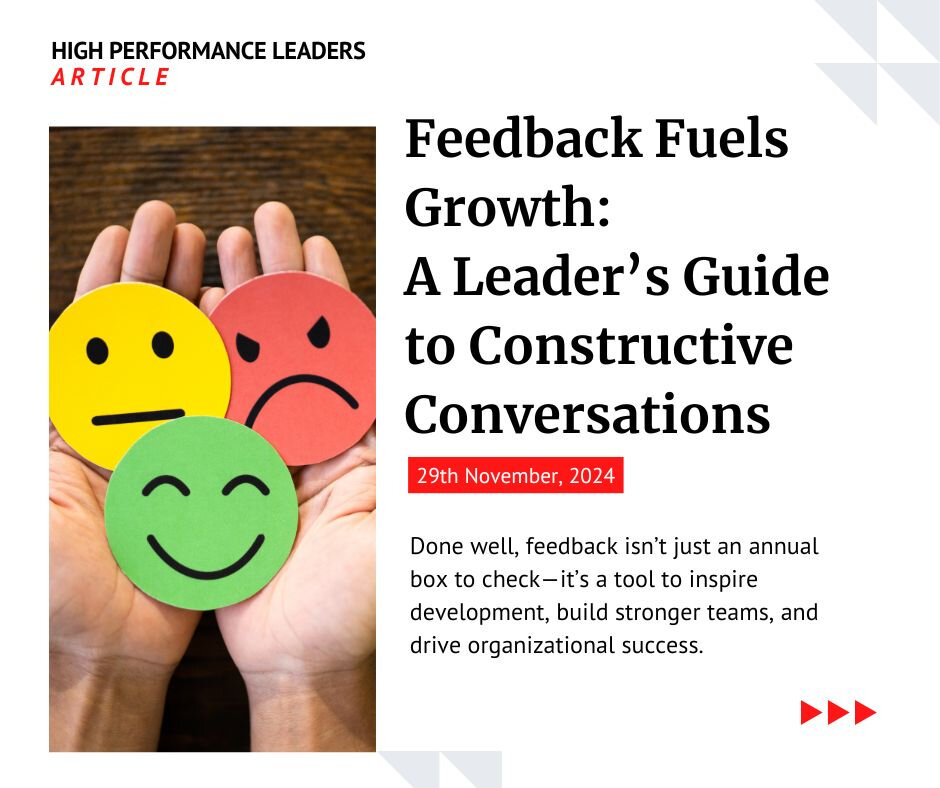
As the year comes to a close, leaders are immersed in performance reviews, goal setting, and reflection. Amid these tasks, one crucial element often holds the key to meaningful growth: feedback. Done well, feedback isn’t just an annual box to check—it’s a tool to inspire development, build stronger teams, and drive organizational success.
However, delivering feedback that truly fuels growth requires intention, skill, and empathy. Here’s how leaders can elevate their feedback practices to help their teams thrive:
1. Shift the Mindset: Feedback as a Gift Feedback isn’t a criticism; it’s an opportunity. Approach feedback conversations with the mindset that your role is to help the other person grow, not just to point out gaps. When you genuinely frame feedback as a gift, it creates a foundation of trust and openness.
Tip: Start conversations by highlighting your commitment to the recipient’s success:
2. Use the 'Start-Stop-Continue' Framework This simple structure ensures your feedback is actionable and balanced:
Start: Highlight new behaviours or practices that could enhance performance.
For example:
3. Be Specific, Timely, and Balanced Generic feedback can feel hollow and unhelpful. To make an impact:
This approach ensures feedback feels relevant and actionable while fostering a sense of accomplishment.
4. Practice Empathy and Active Listening Giving feedback is a two-way conversation, not a one-sided critique. Listen to the recipient’s perspective and ask open-ended questions to understand their challenges and aspirations.
Example Questions: "How did you feel about the outcome of this project?"
5. Follow Through Feedback fuels growth only when it’s part of an ongoing process. Create an action plan and schedule follow-ups to track progress. This demonstrates that you’re invested in their development beyond the review meeting.
Example:
The Impact of Great Feedback When leaders master the art of feedback, they unlock the potential of their teams and create a culture of continuous learning. This ripple effect doesn’t just improve individual performance—it drives innovation, trust, and engagement across the organization.
As you prepare for your year-end reviews, remember that feedback isn’t just a task on your to-do list; it’s a gift that can fuel extraordinary growth. Give it with care, receive it with gratitude, and watch your team flourish. |
||
|
||
|
||
|
|
|
||
|
As the vibrant colours of summer fade into the golden hues of fall, nature offers us an annual reminder of the power of transformation. With its rich symbolism of change, adaptation, and renewal, Autumn is an ideal metaphor for leadership. Just as trees shed their leaves to conserve energy for the winter and prepare for new growth in the spring, leaders, too, must be willing to let go of the old to make space for innovation and future success.
Leaders attuned to the cyclical nature of change can harness the wisdom of autumn to guide their teams through periods of transition and growth. Let’s explore how nature’s lessons during this season can inspire more adaptable, reflective, and resilient leadership.
1. Embrace Letting Go for Future GrowthIn autumn, trees lose their leaves not as a sign of decline but as a crucial step in their renewal process. For leaders, this seasonal shedding symbolizes the importance of consciously letting go of old habits, outdated strategies, or ineffective processes that no longer serve the team’s or organization’s goals.
Letting go can be difficult—whether it's a project that has outlived its potential, a business model that no longer drives results or even relationships that may be hindering progress. But, like trees making space for new leaves, leaders must recognize when it’s time to release the past and embrace the opportunity for growth. By doing so, they create space for innovation, new ideas, and fresh energy to take root.
This process also includes delegating responsibilities and empowering team members to step up, which fosters personal growth within the team and strengthens the entire organization. Leaders open to "letting go" create environments where growth and adaptability are encouraged and expected.
2. Harness the Power of ReflectionAutumn is a time when nature slows down, signalling a period of preparation and reflection. The once-bustling activity of summer gives way to a quieter, more introspective season. Similarly, effective leaders recognize the importance of carving out time for reflection amidst the fast-paced demands of their roles.
Leadership reflection is about taking stock of where you and your team have been, assessing your achievements, learning from setbacks, and evaluating whether current strategies align with future goals. Reflective leaders take the time to review their leadership style, gather feedback from their teams, and recalibrate their priorities. This practice of self-assessment and introspection fosters greater clarity, enabling leaders to make thoughtful, informed decisions as they guide their organizations forward.
Reflection during the fall season can also serve as a moment of recentering—an opportunity to reaffirm values, set new intentions, and plan for the upcoming year. Just as farmers harvest crops in the fall, leaders should "harvest" the insights and lessons from the past months, using them to plant seeds of growth for the future.
3. Adapt to the Season’s DemandsAutumn is a season of unpredictability. One day might be warm and sunny, the next cold and blustery, reflecting the natural flux that often characterizes transition periods. Leaders, too, must learn to be adaptable, recognizing that the ability to pivot and adjust is crucial in changing circumstances.
The unpredictable nature of business demands flexibility. Market conditions shift, team dynamics evolve, and unforeseen challenges arise—whether it’s a global crisis, a technological disruption, or shifts in consumer behaviour. Leaders who are agile and adaptable not only survive but thrive during these times of uncertainty. Just as animals adapt their behaviours and gather resources to prepare for winter, leaders should prepare for change by embracing continuous learning, staying open to new ideas, and being ready to pivot when necessary.
This adaptability can also manifest in the way leaders handle their teams. Different seasons in business require different approaches—whether it’s focusing on efficiency during high-demand periods or emphasizing collaboration and creativity during quieter times. Adaptable leaders read the room, adjust their strategies accordingly, and confidently lead their teams, even during uncertainty.
4. Cultivate Resilience and PatienceIn nature, autumn’s beauty comes with patience and trust in the process. The transition from vibrant summer to bare winter trees is gradual, requiring patience and resilience from nature and those who admire it. Leaders, too, must cultivate resilience and patience as they guide their teams through periods of change.
Building resilience as a leader involves accepting that setbacks and challenges are inevitable. It’s about staying grounded, focused, and positive, even when the path ahead is unclear. Leaders who embody resilience endure challenges and help their teams bounce back stronger. By modelling patience and a calm approach to adversity, leaders can create an environment where their teams feel supported, motivated, and equipped to tackle whatever comes their way.
Autumn also teaches us the importance of pacing ourselves. Just as nature prepares slowly for the rigours of winter, leaders must understand the importance of sustainability—of ensuring their teams aren’t burning out before the year’s end. By pacing workloads, encouraging work-life balance, and prioritizing mental health, leaders can help their teams stay energized and productive through the year's final stretch.
Conclusion: Leading Through Seasons of ChangeAutumn is more than just a season of falling leaves and cooler temperatures—it’s a powerful reminder of the importance of adaptability, reflection, and resilience in leadership. By learning from nature’s rhythms, leaders can cultivate a dynamic and grounded style, ready to embrace both the challenges and opportunities that come with change.
As you navigate this fall season, take time to reflect on the changes you need to embrace, the lessons you’ve learned throughout the year, and how you can adapt your leadership to meet new challenges. Just as nature prepares for a new growth cycle, your leadership can thrive in this season of transformation, positioning you and your team for a successful year ahead. |
||
|
||
|
||
|
||
|
|
|
||
|
Employee engagement and talent retention have been rising challenges across industries over the past year. With alarming increases in burnout during these post-COVID years, today's job market has reached a new height of high turnover and decreased company loyalty. While the reasons for how and why this has happened are numerous and complicated, let's instead focus on what you need to know and what you can do about these challenges.
A survey conducted by Gallup of over 2 million participants across 54 industries found that only 36% of employees feel supported by their leaders and report high levels of engagement at work. If you are good at some quick math, then you will see that this means that a huge 64% of employees in today's markets feel undersupported and potentially disengaged from their work.
So here are 5 things you can do to help boost this number and start growing your employee engagement today:
Provide Leadership Development: Investing in leadership development helps create competent and confident leaders who can inspire and engage their teams. Programs like the ALT (Advanced Leadership Transformation) Program equip leaders with essential skills, fostering a culture of continuous improvement and empowerment. According to the Harvard Business Review, companies that invest in leadership development are 2.5 times more likely to be in the top 25% of financial performers in their industry.
Regularly recognizing and appreciating employees’ efforts boosts morale and motivation. According to a study by Gallup, employees who feel recognized are more engaged, productive, and loyal. Implementing a structured recognition program where achievements are celebrated can significantly enhance engagement levels.
Providing opportunities for professional growth through training, mentoring, and career advancement can increase engagement. LinkedIn research found that 94% of employees would stay longer at a company that invested in their career development. Offering clear paths for advancement and skill development keeps employees motivated and engaged.
Encouraging a healthy work-life balance helps prevent burnout and maintain high levels of engagement. Policies such as flexible working hours, remote work options, and paid time off can contribute to better work-life balance. A study by the American Psychological Association found that employees who feel supported in managing work and personal life are more satisfied and productive.
Creating an environment where open communication is encouraged and valued can significantly boost engagement. Regularly sharing company goals, challenges, and successes fosters trust and a sense of belonging. According to research by the Institute for Public Relations, transparent communication from leadership leads to higher levels of employee engagement and commitment.
Implementing these strategies can significantly enhance employee engagement, leading to a more motivated, productive, and loyal workforce. By providing leadership development, fostering recognition, encouraging professional growth, promoting work-life balance, and fostering open communication, organizations can create an environment where employees feel valued and motivated to contribute to the company's success. If you want more tips on how to increase employee engagement, check out our LinkedIn. |
||
|
||
|
||
|
|
|
||
|
Investing in leadership development is no longer optional but essential. With organizations struggling with talent retention and high turnover rates, what will make a high-performing team member stay? Leadership development has always been a bucket list item that many companies say they will implement "someday," but today's leaders are asking louder and louder: WHEN? What makes it worthwhile for companies to invest time, resources, and money in developing their leaders? What will stop these newly developed leaders from quitting within a few months of their development? Well, there are many more reasons you should consider taking leadership development off the someday to the today list. Here’s why investing in leadership development is a game-changer for your organization.
1. Enhanced Organizational PerformanceLeadership development directly impacts organizational performance. According to a study by McKinsey & Company, organizations with strong leadership development programs are 1.5 times more likely to outperform their peers financially. Increased productivity, streamlined processes, and a growth mindset culture allow teams to truly engage with one another to work ON the business rather than FOR the business. Organizational leadership development standards and unified programming give leaders a shared leadership language.
2. Increased Employee Engagement and RetentionGallup’s research highlights that companies with engaged employees outperform those without by up to 202%. Effective leadership is a crucial driver of engagement. When an organization invests in a leader, that leader will invest back in the company. Receiving development and custom programming shows leaders that they are important and their organization respects their skills. This, in turn, flows back through increased engagement and company loyalty.
3. Fostering Innovation and AdaptabilityToday, a highly sought-after skill as a leader is the ability to innovate and adapt as priorities change and new challenges occur. A report by Deloitte found that companies with strong leadership development programs are 4.2 times more likely to be highly innovative. By enrolling in leadership development, leaders are taught how to handle stressful situations and best practices to get through the everyday. This makes them more efficient overall, leading to more opportunities for innovation and creativity.
4. Building a Sustainable Leadership PipelineSuccession planning is vital for long-term organizational health. The Center for Creative Leadership notes that 77% of organizations report a leadership gap. (See our articles on the Leadership Crisis). By investing in leadership development with a company like High-Performance Leaders, which emphasizes practical application and 1:1 coaching, organizations can build a robust pipeline of future leaders ready to step up when needed.
5. Cultivating a Positive Organizational CultureLeadership significantly influences organizational culture. A positive culture improves employee morale, productivity, and overall business performance. Who doesn't want to work in an organization with strong leadership, a positive work environment, and a growth mindset? If your organization wants to become a top player, the best place to start is with your leaders.
Why Choose High Performance Leaders For Your Leadership Development Needs?High Performance Leaders stands out due to its unique blend of extensive real-world experience and practical application of leadership principles. Here’s what sets us apart:
Decades of Executive Experience: With over 30 years in executive-level leadership roles, High Performance Leaders and Glenn Sommerville bring a wealth of real-world insights and strategies.
ConclusionInvesting in leadership development is one of the most intelligent decisions an organization can make. It leads to enhanced performance, increased engagement, innovation, a sustainable leadership pipeline, and a positive culture. With High Performance Leaders, you benefit from decades of executive experience and practical, actionable training that delivers results. Don’t just lead; lead effectively with High Performance Leaders. |
||
|
||
|
||
|
|
|
||
|
Leaders and their teams face a multifaceted crisis in the ever-evolving landscape of business and organizational dynamics. This leadership crisis comprises various components that together contribute to an environment fraught with uncertainty, stress, and inefficiency. Among these, a conspicuous issue is the alarming lack of accountability. This problem has far-reaching consequences that hinder growth, create burnout, and ultimately undermine the potential of leaders and organizations.
The Leadership Crisis Unveiled
The contemporary leadership landscape is a dynamic and multifaceted arena characterized by a series of complex challenges that leaders and
organizations must navigate. In recent years, these challenges have converged into what can aptly be described as a leadership crisis. This crisis comprises several interrelated components that, when combined, create an environment fraught with uncertainty, stress, and inefficiency. Among these components, the distinct lack of accountability stands out as particularly alarming.
Promotion and Retirement: Leadership in the 21st century faces numerous hurdles. Leaders today are often propelled into their roles at a pace never before witnessed. With the rapidly changing business landscape and the incessant demand for innovation, leaders find themselves ascending the ranks at astonishing speeds. This acceleration often comes at the expense of comprehensive training and mentorship. Leaders, especially those rising through the ranks, have less time to acquire the skills and knowledge required to navigate the intricate world of modern leadership. Consequently, they are left to grapple with their responsibilities without a solid foundation.
This mass movement of Boomer retirement, which leads to accelerated promotion of young leaders, is a double-edged sword. The boomer population is a large mass of the current population, meaning there are not enough young leaders to take their place. While AI and automation help bridge these gaps, organizations must start looking ahead to restructure to use their talent better while not causing burnout to these young leaders, which we are unfortunately witnessing today. Rather than relocating resources and talent and investing in development and mentorship, many organizations are choosing to stack additional responsibilities onto their already overwhelmed leaders, creating mountains of additional work, much of which is unnecessary to the organization.
Leadership Generational Differences: The generational differences in work philosophies have become increasingly apparent in today's diverse workforce. New leaders, often representing the millennial and Generation Z demographics, have introduced a notable shift in how they approach work. Many of them embrace a strict 9-5 mentality, which delineates work hours from personal time, and they are often more hesitant to engage in tasks beyond their regular work hours. This approach is rooted in a belief that personal life and work should remain separate, and their work should be confined within the boundaries of the traditional workday. Unlike previous generations, these leaders may not prioritize organizational loyalty as much and may not consider themselves "team players" in the traditional sense, as they often find it challenging to see direct personal impact from company wins and losses.
While these new leadership styles are not inherently detrimental, they starkly contrast past generations' expectations and practices. These differences necessitate a significant reevaluation of work environments and company cultures.
Organizations must reconsider their company goals and the pathways to achieving these goals if they wish to achieve them, as older methods will not be as successful. To bridge this generational gap and adapt to the evolving leadership landscape, companies should focus on flexible work arrangements that accommodate different work philosophies, where it makes sense and doesn't negatively impact organizational culture and customer values. Embracing technology to facilitate remote work and flexible hours can help accommodate leaders who prefer a more balanced approach to work-life integration. At the same time, organizations must find new ways to instill a sense of purpose and personal impact within young leaders, aligning their contributions with broader company objectives. Often, this team mentality comes from working together in the office. When working from home constantly, it can be easy to become disengaged and disconnected from the company and team goals. In both office and online environments, encouraging open dialogue and collaboration can help create a sense of teamwork, even in a diverse generational workforce, fostering a space where accountability remains a core value. This shift towards adaptability and a more inclusive approach to leadership can lead to a harmonious coexistence of various leadership styles and ultimately contribute to organizational success.
The Accountability Abyss: This is just the tip of the iceberg that could potentially sink our leadership if the course is not changed. The leadership crisis is an intricate and interwoven tangle of related issues. One thread that has recently been brought to our attention is the struggle with accountability from both leaders and teams. This issue manifests itself in multiple ways, contributing to an environment where trust is eroded, motivation wanes, and progress stagnates.
Leaders, for their part, often find it challenging to rely on their teams to meet their commitments. When team members fail to deliver as promised, it leads to incomplete projects and undermines the confidence leaders have in their teams. This lack of trust can lead to micromanagement, which, in turn, further hampers team performance and exacerbates the crisis.
The absence of accountability has profound and far-reaching consequences. One of the most pronounced is the prevalence of overwork and burnout. When commitments are not met, and expectations are unclear, leaders and their teams often stretch themselves thin. The absence of clear priorities compounds this issue. In such an environment, everyone is left firefighting, dealing with immediate issues, and managing crises that seem to materialize out of thin air. Long-term goals and strategies become elusive as leaders and teams struggle to find the time and resources to address them.
Additionally, a lack of accountability leads to inefficient resource allocation. When commitments are not met, human and financial resources are often allocated haphazardly. Projects that were promised but remain incomplete tie up valuable resources which could have been better invested elsewhere. The result is a waste of time, money, and energy on initiatives that again feed back into the loop of frustration and further demotivation.
In essence, a lack of accountability pushes organizations into a perpetual state of crisis management rather than strategy development and execution. Without clear priorities and a commitment to forward planning, leaders and their teams continually react to crises rather than proactively addressing challenges and opportunities. This reactive stance impedes innovation, stunts growth, and leaves organizations vulnerable to unexpected disruptions.
Accountability is the cornerstone of effective leadership and teamwork. Without it, leaders cannot confidently delegate responsibilities, and teams cannot trust their contributions will lead to success. The consequences of a lack of accountability are far-reaching, as we have already seen manifesting in:
Overwork and Burnout: Without clear accountability, leaders and their teams are stretched thin, leading to overwork and burnout. The absence of clear priorities compounds this issue, as everyone ends up firefighting, making it challenging to address long-term goals and strategy. Inefficient Resource Allocation: When commitments are not met, resources are often allocated haphazardly. This results in wasted time, money, and energy on initiatives that may not contribute to the organization's success. Chronic Fire Fighting: A lack of forward planning and prioritization keeps leaders and teams constantly reacting to crises rather than proactively addressing issues. This reactive stance impedes innovation and growth. Fostering a Culture of Accountability: While the leadership crisis may appear daunting, there are ways to mitigate the problem and restore a culture of accountability and efficiency within organizations. Here are some essential steps:
Holding Yourself to the Same Standards
Leaders must set an example by demonstrating their commitment to accountability. When they hold themselves to high standards, it encourages their teams to do the same.
In any organization, leadership accountability isn't just a desirable trait; it's the cornerstone upon which a productive, efficient, and cohesive team stands. Leaders' actions and behaviour, especially in positions of authority and influence, set the precedence for the entire team. When leaders lack accountability, it sends ripples throughout the organization, affecting their own performance and having significant consequences for the entire team.
Leaders who lack personal accountability often fail to meet their commitments, make excuses for their actions or inactions and are quick to deflect blame onto others. This behaviour undermines trust, creates a culture of finger-pointing, and fosters a sense of unfairness among team members. These negative consequences ripple through the organization, creating an atmosphere of chaos and mistrust. As a leader, the implications can be profound when you're confronted with team members who lack personal accountability. Firstly, it places additional pressure and expectations on you to pick up the slack. You may find yourself constantly monitoring their work, following up on unmet commitments, and expending extra effort to ensure that projects are completed on time. This extra workload not only increases your stress and workload but also diverts your focus from strategic leadership tasks and long-term planning.
Furthermore, your team members' lack of personal accountability erodes your ability to delegate effectively. Delegation is fundamental to leadership, allowing you to distribute responsibilities and empower your team. When accountability is absent, you may feel compelled to take on more tasks yourself, leading to burnout and a lack of balance in your work-life equation.
The consequences of a leader's lack of accountability extend beyond the immediate impact on the individual. It influences the entire team, as team members may perceive a lack of fairness and equity. When they observe a leader avoiding responsibility or not being held accountable for their actions, it sends a disheartening message about the organization's values and commitment to fairness and integrity.
No one likes to work with or for a hypocrite. It's important to work on your own accountability before you start working on resolving your team's lack of accountability.
Open Communication
One way to improve your and your team's accountability is to have open lines of communication. Leaders and teams should feel comfortable discussing challenges, setting expectations, and sharing feedback. This creates a collaborative atmosphere that promotes accountability.
Demonstrate to your team when you are being held accountable and the impact that has on both you and the team. Now, this is not a finger-pointing party but rather an honest and open dialogue about sharing your successes and failures as both a leader and a team. Your team may struggle with accountability as they don't perceive any urgency in the tasks given to them.
Open communication is not merely a valuable organizational asset but a fundamental building block for cultivating a culture of accountability. In any leadership role, fostering an environment where team members feel comfortable expressing their thoughts, concerns, and ideas is essential. When lines of communication remain clear and unobstructed, it becomes significantly easier to uphold accountability and address tasks in a timely manner. The impact of this open dialogue within an organization cannot be overstated, as it has far-reaching implications for the team's efficiency and the potential consequences of failing to meet expectations.
Open communication is a conduit for clarifying expectations and aligning team members with their responsibilities. When leaders engage in transparent conversations with their teams, they can set clear goals, assign tasks, and provide essential context for understanding the importance of those tasks. Team members, in turn, can ask questions, seek clarification, and provide feedback on potential challenges they may face in completing their assignments. This exchange ensures that everyone is on the same page and fully comprehends the significance of their contributions.
Certain tasks and deadlines within an organization are important not only for achieving short-term goals but also for maintaining the overall momentum of the team. Timely completion of tasks is critical for workflow continuity, project success, and client satisfaction. These tasks can have significant ramifications when they are not accomplished on schedule.
For instance, a missed deadline for a crucial project can lead to delays in product launches, reduced revenue, and potential damage to the organization's reputation. Clients or stakeholders who were counting on timely deliverables may become dissatisfied, potentially leading to financial losses and a strained professional relationship. In essence, the repercussions of failing to meet deadlines or complete vital tasks within the specified timeframe can be detrimental to an organization's success.
In a culture of accountability and open communication, consequences for failing to meet expectations are not just idle threats but a necessary and constructive part of the process. Leaders must hold themselves accountable to the same standards they set for their team. When they are unable to meet their commitments, it's crucial that they acknowledge their shortcomings and work to address them.
Mastering Time Blocking: A Strategy for Effective Crisis Management While the above strategies for working on accountability are more immediate, this next session offers a vital proactive approach to accountability that will have a lasting impact on both leaders and teams. This tip is from our 4-Steps to TIME Shifting program, which specializes in helping leaders maximize their productivity so that they can get back to the things in their lives that really matter.
Setting the Stage with Time Blocking: Time blocking involves allocating specific time slots for various tasks and activities in your calendar. It's a proactive strategy that helps you prioritize essential work and prevents reactive, last-minute firefighting. By structuring your day, you can create dedicated spaces in your schedule to systematically address recurring issues and crises. Creating Dedicated Crisis Management Time: One key element of time blocking is designing specific time slots for dealing with crises. This practice acknowledges that crises can and will happen, but rather than letting them derail your entire day, you address them in a structured manner. By blocking out both morning and afternoon 20-minute meetings in your calendar labelled as "Crisis Management," you create a routine for managing unexpected challenges. At HPL, we recommend a standard 9:30am and 3:30pm Crisis Management Meeting. These meetings should include just about everyone on your team. When the crisis is identified, only meet with the team members who are directly impacted and cancel the meeting for anyone who isn't or doesn't need to be involved.
This effectively ensures a few things:
Morning Crisis Management Meeting: In the morning, schedule a crisis management meeting to take place at the same time each day, say, 9:30 AM. This meeting is critical for several reasons. First, it allows you to assess the nature and severity of the crisis, which can vary greatly. It's also an opportunity to determine if the crisis is something that needs immediate attention or if it can wait until the crisis management meeting time.
Importantly, this meeting should involve your entire team, and it should be on their calendars as well. This approach ensures that no one is caught off guard by an urgent meeting and allows for effective team collaboration. As you gather more information about the crisis, you can choose to cancel the meeting for those team members who won't contribute meaningfully to the discussion (not within their job description or outside their scope), allowing them to focus on their own tasks.
Keep these meetings concise, lasting no longer than 20 minutes. The purpose is to allocate tasks and responsibilities to address the crisis and ensure everyone is on the same page. Afternoon Crisis Management Meeting: The afternoon meeting, held close to the end of the day, serves as a follow-up session for the crisis management tasks assigned in the morning. This meeting provides an opportunity to review progress, determine what's left to be done to overcome the crisis and ensure that the issue is effectively resolved.
These crises can vary in duration, spanning from a single day to several weeks, depending on their nature. The crucial aspect is that, by dedicating time to dealing with these crises, you free up your schedule to be productive in other areas rather than being consumed by firefighting all day. In essence, time blocking for crisis management is a strategic approach that allows leaders to allocate time to deal with unexpected issues, maintain productivity in other areas, and foster efficient team collaboration. By implementing this structured system, leaders can be better prepared to tackle crises, making them a manageable aspect of their daily routines rather than a disruptive force that throws the entire day into chaos every day! Time blocking is a powerful tool for any leader looking to balance proactive leadership and effective crisis management.
In a nutshell, the article delves into the current leadership crisis, where accountability is sorely lacking. This crisis stems from factors like rapid promotions, the retirement of experienced Baby Boomers, and generational differences in work attitudes. The consequences are burnout, inefficient resource use, and a perpetual cycle of firefighting.
To address this crisis, the article suggests several key steps:
Leadership Accountability: Leaders should set an example by demonstrating personal accountability, as their behaviour significantly impacts the entire team and organization. When leaders lack accountability, it creates a culture of finger-pointing and mistrust.
Open Communication: Encouraging open dialogue and transparent communication between leaders and teams can help clarify expectations and responsibilities, fostering a culture of accountability.
Time Blocking for Crisis Management: Implementing time blocking by scheduling specific time slots for addressing crises allows leaders to manage unexpected challenges proactively. This structured approach helps prevent reactive firefighting and ensures productive team collaboration.
The article emphasizes that accountability is essential for effective leadership and teamwork and should be a cornerstone of organizational culture to achieve long-term success. |
||
|
||
|
||
|
||
|
|
|
HPL Administrator 12 September 24, 2025 |

|
|
Sabrina Sommerville 2 July 21, 2025 |

|
|
Glenn Sommerville 46 May 15, 2025 |


.jpg)




 Adding to this challenge is the Baby Boomer generation's retirement, a significant demographic shift that has left a leadership void within organizations. The accumulated wisdom and experience of these seasoned leaders, acquired over decades of dedicated service, are being lost. This exodus creates a knowledge gap that often proves challenging to fill, further compounding the leadership crisis. As the newer generation takes the reins, they bring different work philosophies and expectations regarding work-life balance. While these new expectations are not misplaced or unreasonable, they require a drastic shift in the current North American work culture, which is not taking place fast enough to keep these new recruits happy and fulfilled in their positions.
  On the flip side, teams often grapple with a sense of uncertainty regarding the promises made by their leaders. When leaders fail to follow through on their commitments or provide vague directives, team members are left confused and frustrated. This breakdown in communication and accountability creates a culture of uncertainty that impacts morale and productivity. The result is a vicious cycle of mistrust, frustration, and inefficiency that permeates the entire organization.
  Working with various leaders and organizations, we at HPL constantly hear complaints that leaders are always firefighting to the point they can never get anything else done. One innovative approach to ensuring that you're not just reacting to crises all day is the concept of time blocking, which can be a game-changer for achieving productivity and crisis management. Let's explore how time blocking and strategic scheduling can help leaders deal with recurring issues and create pockets of productivity in their busy schedules.
  100% Canadian