Leadership is a vital aspect of any organization, be it a small team or a large corporation. A leader's ability to inspire and guide their team toward success can make or break an organization's future. It is essential for leaders to possess certain leadership qualities and skills, develop their own leadership style, and continually work towards effective leadership.
In our articles, we will cover key leadership concepts:
|
|
||
|
When leaders think about waste, we usually picture the classic Lean examples: excess inventory on the floor, motion that doesn’t add value, or defects that cause rework. But there’s another form of waste that is less visible and just as costly: leadership waste.
Leadership waste doesn’t pile up in bins or show up on production reports. Instead, it hides in our calendars, inboxes, and daily routines. It’s the hours spent in unproductive meetings, the endless email threads that never move things forward, and the opportunities missed because leaders are too busy putting out fires. The reality? Just like operational waste, leadership waste drains energy, slows progress, and frustrates teams.
A Lean Lens on Leadership Waste In Lean, we use TIM WOODS to describe the eight classic wastes: Transportation, Inventory, Motion, Waiting, Overproduction, Overprocessing, Defects, and Skills. (If you want a deeper dive into TIM WOODS, we’ve covered that [here—insert HPL link].)
Those wastes show up most obviously in production and operations. But if we look at leadership through the same lens, it’s clear that waste isn’t just about materials and processes, it’s also about how leaders spend their time and attention. Let’s explore three of the biggest culprits.
1. Meetings: The Overproduction of Leadership How many meetings on your calendar this week could have been an email, or dropped altogether?
Too often, leaders default to meetings as the way to communicate, problem-solve, or show accountability. The result is overproduction: too many meetings, running too long, with no clear agenda or outcome.
The waste isn’t just in the hours lost. It’s in the energy your team spends preparing, sitting, and context-switching. Every unnecessary meeting pulls focus away from value-adding work.
Toolkit Tip: Only hold meetings with a clear purpose and defined outcomes. Keep them as short as possible (stand-up style works even in office settings). End every meeting with owners and next steps so there’s no ambiguity coupled with deadline commitments.
2. Miscommunication: Death by a Thousand Emails Think about how many times you’ve typed or read an email chain that stretched to 15 replies and still didn’t produce a decision. That’s miscommunication waste, information that’s vague, fragmented, or simply unnecessary.
The problem isn’t just email. It’s instructions given without clarity. Goals that shift midstream. Leaders who assume “I mentioned it once” equals alignment. The result? Rework, frustration, and lost trust. It’s death by a thousand emails, texts, and half-heard directions.
Toolkit Tip: Use clear, standardized communication. State the purpose, the owner, and the deadline.
Don’t rely only on email, sometimes a quick conversation prevents hours of confusion.
Encourage teams to clarify expectations upfront instead of backtracking later.
3. Missed Opportunities: The Silent Cost of Busyness Perhaps the most damaging waste is what leaders don’t do. When every minute is spent firefighting, answering emails, or attending back-to-back meetings, leaders lose the chance to coach, recognize, or innovate. These missed opportunities rarely appear on a KPI dashboard, but their impact compounds over time.
Toolkit Tip: Block time on your calendar for reflection, coaching, and development. Ask your team for improvement ideas regularly — and act on them. Celebrate progress, not just results. Small wins build momentum.
A Challenge for Leaders Lean isn’t just for operations, it’s a mindset that applies everywhere. Leaders who expect their teams to eliminate waste need to model that same discipline in their own behaviors.
This week, take a hard look at your own calendar, inbox, and routines. Ask yourself:
The first step to eliminating leadership waste is to see it. The next step is to act. Your team and your results will thank you.
|
||
|
||
|
||
|
|
|
||
|
Arnold Schwarzenegger’s journey is a masterclass in reinvention. From Austrian immigrant to bodybuilding champion, Hollywood action star, Governor of California, and now global motivator, he has repeatedly transformed his life while maintaining a single constant: a clear vision of his next goal. For leaders, his story offers practical lessons in skill development, adaptability, and the patience required for long-term success.
Reinvent and AdaptEach stage of Arnold’s life required new skills and perspectives. Today, there is often a misconception that you need to be gifted and talented first and then achieving your goals will fall naturally and easily from there. Arnold decided he wanted to become a bodybuilder, but not just any bodybuilder. He wanted to be Mr. Universe! He knew very little about the sport and decided to move to America to train, as the USA had the resources, facilities and training to help him achieve that dream. After achieving his dream of becoming a world-class bodybuilder, he decided to pursue a career in acting, leaving behind his rigorous weight training for speech therapy, acting classes and auditions (don’t worry, he still went to the gym!) After several years in Hollywood, Arnold again changed his focus with a new goal in mind: to become the Governor of California. For this career change, he needed to know how to navigate politics, as well as manage fundraising and form political allies. Today, as a motivational influencer, he leverages his communication and mentorship skills to motivate and support individuals in enhancing their lives.
The leadership takeaway? Reinvention requires openness to learning and adaptability. Leaders who embrace lifelong learning and are willing to pivot can navigate uncertainty and seize opportunities in rapidly changing environments. Today’s leaders can see the tidal wave of change hurtling towards them. It is said that AI and automation could displace a significant number of jobs. For example, it's estimated that up to 30% of current U.S. jobs could be automated by 2030, with 60% having tasks significantly modified by AI (National University). One of the most important skills for today’s leaders is the ability to adapt and learn as they grow.
Patience, Resilience, and Iterative ProgressArnold was not an overnight success. Every major goal took years of disciplined training, repeated failures, and constant course corrections. He faced setbacks, lost competitions, film flops, and political challenges, but he consistently pushed forward, learning from each experience. He critically reflected on these losses and looked for new ways to approach problems. He also took every opportunity to block out the noise. Today’s leaders often fail to see that Arnold's kind of dedication and goal-chasing requires sacrifice. It’s important to decide what is and is not important to you and your goals. Arnold was an incredible actor, but he didn't handle childcare, household chores or food preparation very well! You can’t be the best at everything; some things have to be outsourced, delegated or dropped.
Leadership lesson: Achieving ambitious goals requires resilience and reflection. Regularly evaluate your progress, learn from failures, and adjust your strategy while keeping the ultimate vision in mind. Make sure you don't have too many goals all at once and that your goals are in alignment.
Focus on Skill-BuildingArnold didn’t try to be perfect at everything. Instead, he identified the skills essential for each goal and pursued mastery in those areas. Whether it was acting techniques, political strategy, or public speaking, he devoted deliberate effort to the competencies that mattered most.
“I never wanted to be the best at everything. I wanted to be the best at what mattered most for my goals.” (Arnold’s Pump Club) For leaders, this illustrates the value of prioritizing development by investing time and energy where it counts most, rather than spreading oneself too thin.
Leadership TakeawayArnold Schwarzenegger’s path shows that success is rarely linear. It’s a combination of targeted skill-building, perpetual progress, resilience, and the courage to reinvent oneself.
Leaders can apply this by:
|
||
|
||
|
||
|
||
|
|
|
||
|
UPDATE: SEPTEMBER 2025 The COJG has been suspended for review. This grant is on hold until further notice from the Canadian Government.
Did you know your organization could receive government funding to support employee training and leadership development?
The Canada-Ontario Job Grant (COJG) is a government initiative that helps employers invest in their workforce. Through the program, businesses can receive up to $10,000 per employee to cover training costs.
What Does This Mean for You?
If you’re considering one of HPL’s leadership development programs, like ALT, LFTM, Leading Today or Lean 4 Leaders Bootcamp, you may be eligible to have a significant portion of the costs covered by the COJG.
Funding Highlights:
Who Can Apply? Most private and non-profit employers in Ontario are eligible, provided they:
�� HPL clients have successfully used COJG to attend our programs. We’re happy to support you through the application process.
Please note that if you choose to apply for the COJG, only employees who receive a certificate of completion are eligible for this grant. The grant is awarded by the government of Ontario and is paid out after proof of successful program completion.
Ready to Explore Funding? Visit the official COJG website for eligibility and application details. |
||
|
||
|
||
|
|
|
||
|
Silos rise up all around us in our organizations. They have been built slowly over time, usually unintentionally, but with detrimental results. Teams don't have visibility on how they affect each other’s work. Tasks are done in isolation, information is left stranded between departments, and frustration is felt across teams and departments.
While strategy meetings and process changes have their role, some of the most effective fixes start on a very different level, one that is often overlooked. A BBQ. A trivia board. A baby photo guessing game. These may seem like lighthearted distractions, but they have the power to reconnect teams, rebuild trust, and break down barriers that formal systems have left untouched.
Why Socialization at Work Isn’t Just “Extra”
When people are known beyond their job titles, communication is improved, help is more freely offered, and collaboration is made easier across departments. For many leaders, these connections can be strengthened not just through structure but through shared experience and informal moments of fun.
You may be surprised how much your team has in common with other teams. Misery loves company, but laughs are also best shared between friends. By creating opportunities to connect and find common ground with other leaders and teams, you are also giving people an icebreaker to start conversations.
From Guess-the-Baby to 5S Showdowns: Events That Actually Work
Creating connection does not require a large budget or a corporate retreat. These simple ideas can be introduced quickly and adapted to suit any team:
The Leadership ROI of Fun
Even when fun cannot be measured directly on a spreadsheet, it impacts the bottom line.
Team members who feel included and appreciated are more likely to stay, more willing to contribute, and more likely to collaborate outside their silos. Energy is boosted. Loyalty is earned. Outcomes are improved.
What You Can Do as a Middle Manager
You do not need to wait for approval from the top. Culture is built from every level, and middle managers are perfectly positioned to start the momentum . Try a cross-departmental game. Start a shared whiteboard. Host a simple lunch or trivia board. The goal is not just fun; it is alignment, engagement, and trust. The walls between departments were not built overnight. But they can be brought down, one shared laugh at a time. |
||
|
||
|
||
|
|
|
||
|
While many see summer as a time to slow down, great leaders know it’s actually the perfect moment to pause with purpose. There’s a phrase often used in military and tactical training:
This idea was popularized in Navy SEAL training and firearms instruction and reminds us that intentional movement, done with clarity and control, is more effective than rushed effort. When you slow down and remove unnecessary friction, you create flow. And when your actions are smooth and practiced, they become faster, more precise, and more impactful in high-pressure moments. This isn’t just a tactical principle. It’s a leadership one.
In the context of your year, summer is the “slow.” It’s the breathing room in the middle of chaos. When used well, this season helps you build smooth calm clarity, stronger relationships, aligned goals, so that when fall and Q4 arrive, your team can move with speed and confidence. Here’s how to make the most of it.
Reflect: Use the Quiet to Look InwardSummer often gifts us what the rest of the year takes away: space. With fewer interruptions and slower rhythms, leaders finally have room to zoom out and consider the big picture. This makes it the ideal time to reflect, not just on business goals, but on your leadership.
That reflection doesn’t have to wait for a formal retreat or offsite. It can happen while you’re on a solo walk, sitting on a dock, or journaling with your morning coffee. The distance from the day-to-day, even just for a week away, can offer clarity that’s hard to access in the thick of operations.
Try asking yourself:
Taking time to reflect is the first step to smoothing out the rough edges in how you lead. It’s slow but it sets the stage for strategic speed.
Reconnect: Invest in People, Not Just ProjectsSlowing down also creates space to re-engage with what matters most: your people. Strong leadership isn’t just about what you accomplish; it’s about the relationships you build along the way. Summer’s lighter pace gives you room to reconnect with your team, not just to manage performance, but to build trust.
Use this time to:
These conversations don’t need to be long or formal. They need to be real. This human connection builds the “smooth” relational trust and alignment that make your team more cohesive, responsive, and ready to act when momentum picks up in the fall.
As Simon Sinek says: “Leadership is not about being in charge. It is about taking care of those in your charge.”
Summer gives you time to do exactly that.
Reboot: Set the Stage for a Strong FallSummer is also a natural time to reset. The second half of the year is looming. Goals may have drifted, priorities may have shifted, and energy levels may have dipped. Great leaders use this seasonal midpoint to realign.
This could mean:
This is the bridge from smooth to fast. By getting clear and aligned now, you’re removing obstacles and ambiguity that slow your team down later. When fall hits, you’ll be ready, not scrambling.
|
||
|
||
|
||
|
|
|
||
|
The long weekend is coming up, and like many Canadians, I’m heading north, where the WiFi gets weaker and the leadership lessons get a little stronger.
I don’t own a cottage, but I’ve spent decades soaking up summer weekends at other people's. Growing up, my family spent summers at a trailer park. These days, I’m lucky to have friends—and a sister—who generously share their cottages with me. Over the years, I've learned that what looks like a peaceful escape often hides a surprising amount of logistics, coordination, and people management. And the more time I’ve spent dockside, the more I’ve come to see how many of the same principles we talk about in leadership show up in cottage life.
1. Project Management Is Real It’s easy to laugh at the idea of “managing” a long weekend—but when you look closer, it’s exactly that. Food needs buying, people need beds, the fridge needs room for six types of drinks and one vegetable tray, and somehow, there’s never enough ice.
Someone is making all of this happen, and more often than not, they’re managing invisible moving parts. Most of the time this burden falls on the shoulders of one ring leader.
You wouldn’t call it a project plan, but it might as well be! I have so much respect for the people who make this happen! Never missing a single detail and keeping everything running on time and efficiently.
At work, project management is about anticipating needs and staying two steps ahead. At the cottage, it's making sure you have enough lifejackets and no one forgot the mustard. Both matters.
I think that when you reframe a cottage weekend as a short-term high stakes project that requires a plan and timeline you begin to think differently. Now I am not suggesting that you should treat the weekend like work, but when you plan and prep ahead of time, collaborate with your stakeholders (your partner, kids, and guest) it makes it easier to distribute tasks, promote buy-in and help relive a lot of the stress that goes into these epic trips.
When’s the last time you planned something “casual” that turned out to need real coordination?
2. Crisis Management (a.k.a. The Dock Is Floating Away) It's a universally known truth that things will go sideways at some point. A thunderstorm hits while you're on the lake, the power flickers out mid dinner prep, the boat won’t start, and someone slips on the rocks. Cottage weekends are full of small (and not-so-small) moments where things don’t go to plan.
You learn quickly: yelling doesn’t help. Pointing fingers doesn’t fix the problem. What does? Staying calm. Thinking clearly. Doing what you can, with what you’ve got. At work, the same rules apply. Teams look to leaders not just for answers—but for steadiness. You don’t have to know everything, but how you show up in the moment and change the outcome.
What kinds of methods can you take to try and minimize these crises? Do you check the weather regularly? Do you have your emergency kit restocked and ready for the summer? How about your BBQ? When did you last clean it? Crisis management starts at prevention.
3. Vision & Planning Matter—Even at the Lake Sure, cottage weekends are supposed to be easygoing. But the best ones. They don’t happen by accident.
Someone had a vision: the campfire, the tubing, the morning coffee on the dock. And someone made a plan to make it possible. That’s leadership too.
It’s the same in our roles. Whether you're launching a product, building a team, or just trying to improve one part of your operation—you need clarity. You need to know what great looks like, and work backwards from there.
What tools do you need to make it happen? What resources are required? What's your timeline! This is a Biggy! You can’t go on a beer run when you and your buddies spent the morning drinking, I mean, emptying out the beer fridge. You’ve got to plan for that!
What would happen if you approached your next work week like a long weekend: with intention, a few anchor moments, and enough flexibility to enjoy it?
4. Boundaries Aren’t Just for the Property Line Every cottage has rules—written or unspoken. Shoes off in the cabin. No wet towels on the couch. Quiet time after 10. Don’t touch the host’s special bourbon. These aren’t just about cleanliness or comfort—they’re about respect and keeping things running smoothly when people are sharing space.
And yet, not everyone naturally follows them. Some guests pitch in without being asked. Others treat it like an all-inclusive resort. If you’ve ever found yourself cleaning up solo while someone else cracks another drink, you’ve seen what happens when boundaries aren’t set—or enforced.
And here’s the thing about rules—they only work if people actually know about them.
Setting boundaries isn’t just about enforcing rules when they’re broken; it’s about communicating expectations before the weekend even begins. The best cottage hosts don’t just hope everyone will show up with food, help clean, and be respectful—they create a group chat, share itineraries, lists and schedules, they make a signup sheet and/or a chore chart, they say, “Hey, can you bring X?” They’re clear. They’re fair. They’re intentional. And when someone doesn’t follow through? You learn. Maybe they forgot to bring the groceries they promised. Maybe they disappeared when it was their turn to make dinner. Maybe they treated the weekend like a getaway but forgot it was also a shared effort.
You can’t control people. But you can make decisions based on patterns. Sometimes accountability at the cottage looks like not extending that same invite next time. And sometimes, it looks like letting go—accepting someone’s limits and adjusting your expectations accordingly. It’s always good to have a backup plan! (see project management)
The same goes for leadership. Not everyone will rise to the occasion. Some team members will drop the ball. Some won’t read the room. It’s not about taking it personally—it’s about noticing what’s consistent, being clear in your communication, and holding people accountable through action, not just feedback. Boundaries aren’t about being rigid. They’re about making the experience better for everyone—so that the people who do show up, contribute, and care. Don’t burn out carrying the whole load.
How clearly have you communicated the “cottage rules” on your team? And what do you do when someone just keeps showing up empty-handed?
5. Saying No and Finding Time to Relax There’s a point in every cottage weekend when the host starts to hit their limit—whether it’s too many people, too much noise, or not enough sleep. I’ve seen it in friends, in family, and I’ve felt it myself: the quiet exhaustion that comes from being “on” for too long.
And yet, so few people say it out loud. At work, the same thing happens. Leaders stretch themselves thin trying to make everything go smoothly—for everyone but themselves. But saying “no” or “not this weekend” is often the bravest and wisest thing you can do.
Setting boundaries, especially with family can be tricky! There seems to be a strange Canadian phenomenon that the second you get a cottage you are suddenly expected to host everyone you’ve ever met every week for the whole summer! It’s important to prioritize and protect your peace. Just like at work, block time in your calendar. These weekends are family weekends but these ones are available, first come first serve! Remember to say no by saying-
YES: Yield, Explain, Suggest.
One of the best parts of being at the cottage is the downtime. Sometimes it’s busy and the weekend flies by but within the chaos you have these pockets of time to sit and reflect. You watch the sun set sitting on the dock, you enjoy the early morning stillness with your first cup of coffee in the morning before anyone else is awake. The spaces of companionable silence that emerge while sitting around the campfire. These moments recharge us and remind us what we are doing it all for.
When was the last time you took a moment at work to be fully present? To set aside time to think on your project trajectory and have space for some creative thinking and problem solving? Why can’t that fit into the little pockets of your day? I highly recommend you try. Find those calm moments in the eye of the storm and take a moment to think and reflect.
Conclusion Cottage life reminds me that leadership isn’t always about big speeches or strategic plans. Sometimes, it’s how you react when the propane runs out. Or how you carve out 30 quiet minutes on the dock before the day begins.
Whether you're heading north this weekend or staying home, I hope you find a little space to recharge—and maybe reflect on the kind of leader you’re becoming. Not just the one who gets things done but also the one who brings calm, clarity, and care to the people around them. I urge you to take some time to think about how you can bring these cottage leadership lessons back to the city.
|
||
|
||
|
||
|
|
|
||
|
We often assume that accountability comes from holding people to high standards, being direct, or cracking down when results slip. But if that’s the only tool in your leadership toolkit, you’ll likely create a culture of fear, not ownership. Here’s the truth: Psychological safety is the fuel that drives real accountability.
What Is Psychological Safety? Psychological safety is the belief that you can speak up, make mistakes, and ask questions without fear of humiliation or retaliation. It doesn’t mean avoiding tough conversations — it means creating an environment where people feel safe enough to engage in them.
The Link Between Safety and Accountability When team members don’t feel safe, they go into protection mode:
In contrast, when psychological safety is high, people take ownership:
This is where accountability thrives — not through fear, but through trust.
Common Mistakes Leaders Make Using blame instead of curiosity
Rewarding silence
Avoiding feedback conversations
Creating Safety and Accountability It’s not either/or. Great leaders build both.
Here’s how:
Final Thought Psychological safety isn’t a “nice-to-have.” It’s the foundation for high performance. If you want a team that takes ownership, speaks up, and holds each other to a high standard — build a culture where it’s safe to do so. |
||
|
||
|
||
|
|
|
||
|
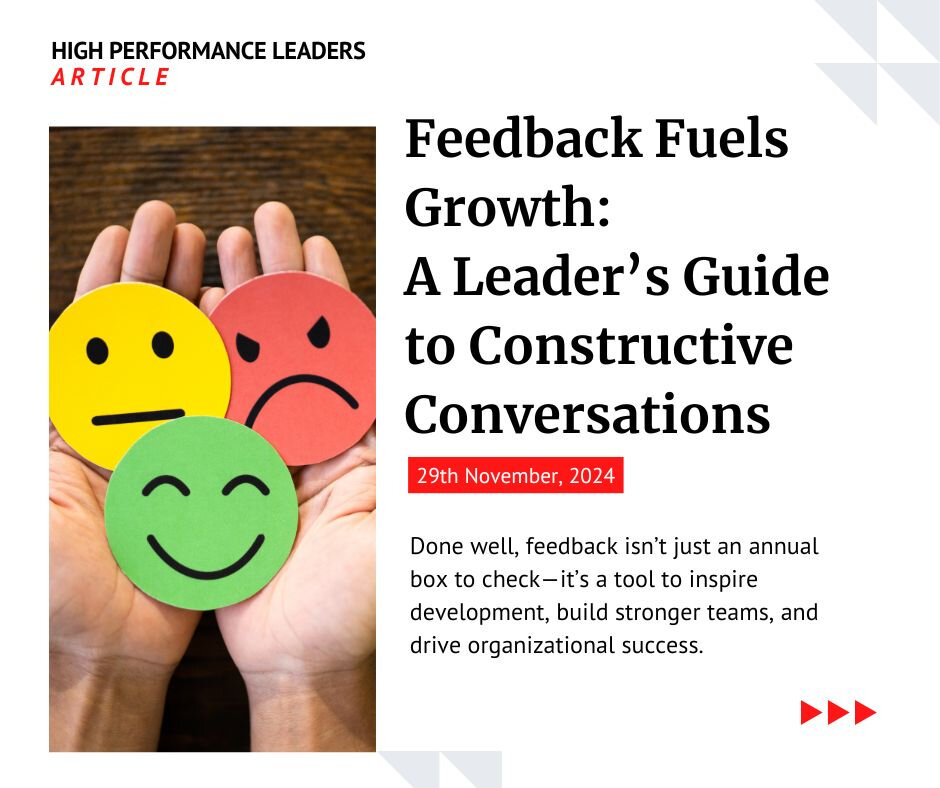
As the year comes to a close, leaders are immersed in performance reviews, goal setting, and reflection. Amid these tasks, one crucial element often holds the key to meaningful growth: feedback. Done well, feedback isn’t just an annual box to check—it’s a tool to inspire development, build stronger teams, and drive organizational success.
However, delivering feedback that truly fuels growth requires intention, skill, and empathy. Here’s how leaders can elevate their feedback practices to help their teams thrive:
1. Shift the Mindset: Feedback as a Gift Feedback isn’t a criticism; it’s an opportunity. Approach feedback conversations with the mindset that your role is to help the other person grow, not just to point out gaps. When you genuinely frame feedback as a gift, it creates a foundation of trust and openness.
Tip: Start conversations by highlighting your commitment to the recipient’s success:
2. Use the 'Start-Stop-Continue' Framework This simple structure ensures your feedback is actionable and balanced:
Start: Highlight new behaviours or practices that could enhance performance.
For example:
3. Be Specific, Timely, and Balanced Generic feedback can feel hollow and unhelpful. To make an impact:
This approach ensures feedback feels relevant and actionable while fostering a sense of accomplishment.
4. Practice Empathy and Active Listening Giving feedback is a two-way conversation, not a one-sided critique. Listen to the recipient’s perspective and ask open-ended questions to understand their challenges and aspirations.
Example Questions: "How did you feel about the outcome of this project?"
5. Follow Through Feedback fuels growth only when it’s part of an ongoing process. Create an action plan and schedule follow-ups to track progress. This demonstrates that you’re invested in their development beyond the review meeting.
Example:
The Impact of Great Feedback When leaders master the art of feedback, they unlock the potential of their teams and create a culture of continuous learning. This ripple effect doesn’t just improve individual performance—it drives innovation, trust, and engagement across the organization.
As you prepare for your year-end reviews, remember that feedback isn’t just a task on your to-do list; it’s a gift that can fuel extraordinary growth. Give it with care, receive it with gratitude, and watch your team flourish. |
||
|
||
|
||
|
|
|
||
|
As the vibrant colours of summer fade into the golden hues of fall, nature offers us an annual reminder of the power of transformation. With its rich symbolism of change, adaptation, and renewal, Autumn is an ideal metaphor for leadership. Just as trees shed their leaves to conserve energy for the winter and prepare for new growth in the spring, leaders, too, must be willing to let go of the old to make space for innovation and future success.
Leaders attuned to the cyclical nature of change can harness the wisdom of autumn to guide their teams through periods of transition and growth. Let’s explore how nature’s lessons during this season can inspire more adaptable, reflective, and resilient leadership.
1. Embrace Letting Go for Future GrowthIn autumn, trees lose their leaves not as a sign of decline but as a crucial step in their renewal process. For leaders, this seasonal shedding symbolizes the importance of consciously letting go of old habits, outdated strategies, or ineffective processes that no longer serve the team’s or organization’s goals.
Letting go can be difficult—whether it's a project that has outlived its potential, a business model that no longer drives results or even relationships that may be hindering progress. But, like trees making space for new leaves, leaders must recognize when it’s time to release the past and embrace the opportunity for growth. By doing so, they create space for innovation, new ideas, and fresh energy to take root.
This process also includes delegating responsibilities and empowering team members to step up, which fosters personal growth within the team and strengthens the entire organization. Leaders open to "letting go" create environments where growth and adaptability are encouraged and expected.
2. Harness the Power of ReflectionAutumn is a time when nature slows down, signalling a period of preparation and reflection. The once-bustling activity of summer gives way to a quieter, more introspective season. Similarly, effective leaders recognize the importance of carving out time for reflection amidst the fast-paced demands of their roles.
Leadership reflection is about taking stock of where you and your team have been, assessing your achievements, learning from setbacks, and evaluating whether current strategies align with future goals. Reflective leaders take the time to review their leadership style, gather feedback from their teams, and recalibrate their priorities. This practice of self-assessment and introspection fosters greater clarity, enabling leaders to make thoughtful, informed decisions as they guide their organizations forward.
Reflection during the fall season can also serve as a moment of recentering—an opportunity to reaffirm values, set new intentions, and plan for the upcoming year. Just as farmers harvest crops in the fall, leaders should "harvest" the insights and lessons from the past months, using them to plant seeds of growth for the future.
3. Adapt to the Season’s DemandsAutumn is a season of unpredictability. One day might be warm and sunny, the next cold and blustery, reflecting the natural flux that often characterizes transition periods. Leaders, too, must learn to be adaptable, recognizing that the ability to pivot and adjust is crucial in changing circumstances.
The unpredictable nature of business demands flexibility. Market conditions shift, team dynamics evolve, and unforeseen challenges arise—whether it’s a global crisis, a technological disruption, or shifts in consumer behaviour. Leaders who are agile and adaptable not only survive but thrive during these times of uncertainty. Just as animals adapt their behaviours and gather resources to prepare for winter, leaders should prepare for change by embracing continuous learning, staying open to new ideas, and being ready to pivot when necessary.
This adaptability can also manifest in the way leaders handle their teams. Different seasons in business require different approaches—whether it’s focusing on efficiency during high-demand periods or emphasizing collaboration and creativity during quieter times. Adaptable leaders read the room, adjust their strategies accordingly, and confidently lead their teams, even during uncertainty.
4. Cultivate Resilience and PatienceIn nature, autumn’s beauty comes with patience and trust in the process. The transition from vibrant summer to bare winter trees is gradual, requiring patience and resilience from nature and those who admire it. Leaders, too, must cultivate resilience and patience as they guide their teams through periods of change.
Building resilience as a leader involves accepting that setbacks and challenges are inevitable. It’s about staying grounded, focused, and positive, even when the path ahead is unclear. Leaders who embody resilience endure challenges and help their teams bounce back stronger. By modelling patience and a calm approach to adversity, leaders can create an environment where their teams feel supported, motivated, and equipped to tackle whatever comes their way.
Autumn also teaches us the importance of pacing ourselves. Just as nature prepares slowly for the rigours of winter, leaders must understand the importance of sustainability—of ensuring their teams aren’t burning out before the year’s end. By pacing workloads, encouraging work-life balance, and prioritizing mental health, leaders can help their teams stay energized and productive through the year's final stretch.
Conclusion: Leading Through Seasons of ChangeAutumn is more than just a season of falling leaves and cooler temperatures—it’s a powerful reminder of the importance of adaptability, reflection, and resilience in leadership. By learning from nature’s rhythms, leaders can cultivate a dynamic and grounded style, ready to embrace both the challenges and opportunities that come with change.
As you navigate this fall season, take time to reflect on the changes you need to embrace, the lessons you’ve learned throughout the year, and how you can adapt your leadership to meet new challenges. Just as nature prepares for a new growth cycle, your leadership can thrive in this season of transformation, positioning you and your team for a successful year ahead. |
||
|
||
|
||
|
||
|
|
|
||
|
Employee engagement and talent retention have been rising challenges across industries over the past year. With alarming increases in burnout during these post-COVID years, today's job market has reached a new height of high turnover and decreased company loyalty. While the reasons for how and why this has happened are numerous and complicated, let's instead focus on what you need to know and what you can do about these challenges.
A survey conducted by Gallup of over 2 million participants across 54 industries found that only 36% of employees feel supported by their leaders and report high levels of engagement at work. If you are good at some quick math, then you will see that this means that a huge 64% of employees in today's markets feel undersupported and potentially disengaged from their work.
So here are 5 things you can do to help boost this number and start growing your employee engagement today:
Provide Leadership Development: Investing in leadership development helps create competent and confident leaders who can inspire and engage their teams. Programs like the ALT (Advanced Leadership Transformation) Program equip leaders with essential skills, fostering a culture of continuous improvement and empowerment. According to the Harvard Business Review, companies that invest in leadership development are 2.5 times more likely to be in the top 25% of financial performers in their industry.
Regularly recognizing and appreciating employees’ efforts boosts morale and motivation. According to a study by Gallup, employees who feel recognized are more engaged, productive, and loyal. Implementing a structured recognition program where achievements are celebrated can significantly enhance engagement levels.
Providing opportunities for professional growth through training, mentoring, and career advancement can increase engagement. LinkedIn research found that 94% of employees would stay longer at a company that invested in their career development. Offering clear paths for advancement and skill development keeps employees motivated and engaged.
Encouraging a healthy work-life balance helps prevent burnout and maintain high levels of engagement. Policies such as flexible working hours, remote work options, and paid time off can contribute to better work-life balance. A study by the American Psychological Association found that employees who feel supported in managing work and personal life are more satisfied and productive.
Creating an environment where open communication is encouraged and valued can significantly boost engagement. Regularly sharing company goals, challenges, and successes fosters trust and a sense of belonging. According to research by the Institute for Public Relations, transparent communication from leadership leads to higher levels of employee engagement and commitment.
Implementing these strategies can significantly enhance employee engagement, leading to a more motivated, productive, and loyal workforce. By providing leadership development, fostering recognition, encouraging professional growth, promoting work-life balance, and fostering open communication, organizations can create an environment where employees feel valued and motivated to contribute to the company's success. If you want more tips on how to increase employee engagement, check out our LinkedIn. |
||
|
||
|
||
|
|
|
HPL Administrator 12 September 24, 2025 |

|
|
Sabrina Sommerville 2 July 21, 2025 |

|
|
Glenn Sommerville 46 May 15, 2025 |


.jpg)


 100% Canadian